[Newsletter] Japanese Municipalities' Efforts to Conserve Groundwater
JFS Newsletter No.133 (September 2013)
 Copyright Junji Hashimoto. All Rights Reserved.
Groundwater is present almost everywhere except in deserts. Depletion of groundwater from over-use is a problem in many countries -- consequences include ground subsidence and a lowering of the water table beyond the reach of wells. Japan is a wet country but groundwater issues are occurring even here.
Ever-Growing Use of Groundwater
Since the Great East Japan Earthquake on March 11, 2011, the use of groundwater has been growing in Japan. It is reported that as many as 20,000 wells were dug in the year after the earthquake. Many wells were drilled to provide victims with water in disaster zones where tap water sources were nullified due to the tsunami, as well as on high ground sites where evacuees are living temporally.
Raised awareness about disaster prevention and safety had led to increasing use of bottled water even outside the disaster zone. After the nuclear accident at Fukushima Nuclear Power Plant No.1 belonging to Tokyo Electric Power Co., a radioactive iodine level measured at a water treatment facility in Tokyo was 210 becquerels (Bq) per kilogram (kg), well over the interim legal safety limits for infants (100 Bq per kg) current at the time. After it was reported that the Tokyo Metropolitan Government urged residents not to give tap water to babies, bottled water quickly disappeared from store shelves.
A request from the Ministry of Agriculture, Forestry and Fisheries to manufacturers to expand production and supplies of bottled water resulted in rapid growth of the bottled water market in 2011 by up to 26 percent compared to the previous year in both volume and revenue. Demand for bottled water continues to increase since then, as people continue to stockpile water and as a result of new demand from consumers who previously were not in the habit of drinking bottled water. Thus, demand for groundwater has been continuously expanding.
Under these circumstances, some Japanese municipalities have been actively conserving water resources during the last few years. Especially remarkable is the establishment of relevant municipal ordinances. Below we report on trends in Japanese municipalities' efforts to conserve groundwater.
Kumamoto Prefecture
In 1978 when northern Kyushu was stricken by a severe drought, Kumamoto Prefecture enacted the Groundwater Preservation Ordinance, which requires those who are planning to pump up groundwater to notify the prefecture in advance. This ordinance was amended in 2012 to require business operators pumping up large amounts of groundwater to obtain permission from the Governor, to install instruments to measure volumes of groundwater pumped, and to submit and implement plans for recharging the groundwater resource. Those who pump up groundwater without permission can be punished by imprisonment for up to one year or a fine of up to 500,000 yen (about U.S. $5,100).
The trigger for the amendment was groundwater depletion. Although the volume of groundwater pumped in Kumamoto decreased in 2008 to 180 million tons, 75 percent of the figure for 1991, the water table was continuing to sink. One prefectural official said, "We have realized that water for daily use has slowly started to decrease. Unless we take some action now, we will find ourselves without usable groundwater in the future."
One region that uses large quantities of water in the prefecture is Kumamoto City, with its relatively large population. The city is located in the lower reaches of an aquifer that is recharged by inflow from the middle reaches of the Shirakawa River located on the upper side of the groundwater basin. Upstream residents are aware that Kumamoto City is using water originating from their region, but urban residents seldom think about where their water comes from.
Successful enactment of this kind of ordinance depends on whether people have a common awareness that they are sharing an aquifer. In cooperation with municipalities, Kumamoto Prefecture measured groundwater levels and conducted surveys for a hydrological map showing the structure and flows of groundwater systems in corporation with cities, towns and villages in the prefecture. This cooperative effort brought a feeling of unity to the prefecture, leading to the ordinance amendment.
Kumamoto City
As the prefectural capital, Kumamoto City is also making various efforts. In 2013, the city won the United Nations' Water Best Practices Award, "Water for Life," in recognition of its model efforts to utilize paddy fields to maintain water supplies in cooperation with various organizations. Some examples are introduced below.
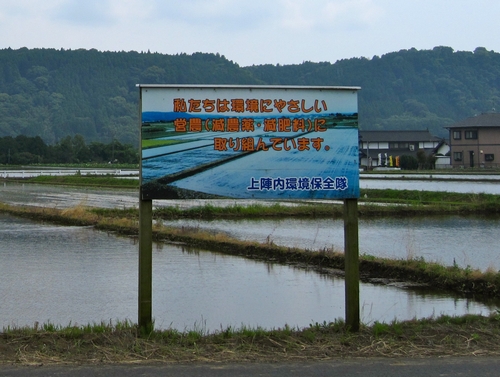
In the district surrounding Kumamoto City, most daily life water supplies come from groundwater, and groundwater levels have declined in recent years due to the decreased number of wet-field rice paddies under cultivation. The amount of groundwater recharge (the amount of surface water seeping into the ground) in the Kumamoto district is 640 million tons a year, and one third of this amount comes from rice paddies. Rice paddies along the midstream of the Shirakawa River in particular provide five to 10 times more water as rice paddies in other areas. However, the number of rice paddies functioning as part of the recharge system has decreased. The area of wet-field rice being planted declined from 15,000 hectares in 1990 to 10,000 hectares in 2011.
This was the background to the recharge project started in Kumamoto. In the late 1990s, Professor Tsutomu Ichikawa at Tokai University reported that spring water feeding Ezu Lake in Kumamoto City decreased by 20 percent in 10 years. At that time, the Sony corporate group decided to build a semiconductor factory (Sony Semiconductor Co.'s Kumamoto Technology Center) in the groundwater recharge area. Because large quantities of groundwater are needed to produce semiconductors, local people were worried that the factory might pump up so much water that it would impact surrounding areas.
Their worries induced Sony to consider various measures. In fiscal 2003, Sony started a groundwater recharge project working cooperatively with local farmers, environmental NGOs and agricultural organizations. The project sought farmers who would cooperate by introducing water from the river into their paddy fields during the off season so as to recharge the groundwater. Sony offered to cover all expenses of the project. More recently, the Kumamoto Ground Water Foundation is collecting donations from small and medium-sized companies that use groundwater to promote recharge from rice paddies.
 Copyright Junji Hashimoto. All Rights Reserved.
This project seems to be attracting favorable comments from cooperating farmers, for example, "It is good because weeds don't grow in flooded paddies. Removing weeds during this season is a hard work, so it is helpful," and "This project can eliminate replanting failure." Meanwhile, there is a movement to sell rice grown in these paddies as brand-name rice. By actively purchasing such local products, consumers can support the project. Buying rice cultivated in groundwater recharge areas makes a real contribution to maintaining groundwater resources.
By eating this rice, local people can protect agriculture as well as groundwater. Even local people working in Tokyo and Osaka can support their hometowns by eating this rice. Kumamoto City's efforts to build this social mechanism earned them the award.
 Copyright Junji Hashimoto. All Rights Reserved.
Complete Replenishment Groundwater Recharge Rule Established in Azumino, Nagano
Among groundwater initiatives of local governments, the policy in Azumino City, Nagano Prefecture, stresses its groundwater recharge rule. In addition to rules on groundwater collection, such as requirements for notification or permission at the time of water withdrawal, it includes measures to proactively increase groundwater, such as introducing water into paddies that would benefit from crop rotation. These measures are paid for by taxes on companies and citizens.
In Azumino City, some people have been complaining over the last few years ago that the spring water levels have become lower, affecting the cultivation of wasabi horseradish, a specialty crop of the area, killing the plants or otherwise making their cultivation impossible. Spring water and groundwater in Azumino are used for fish farming, agriculture and wasabi culture as well as for people's daily life needs and industry. In spite of the efforts of people to point to the sinking water table, there were no rules concerning groundwater use, and no specific measures for its preservation or recharge.
In July 2011, stakeholders established the Groundwater Conservation Study Committee, headed by Katsuyuki Fujinawa, a professor of geohydrology at Shinshu University. Initially, committee members were at loggerheads because they had been in conflict over the use of groundwater. They had been blaming each other for the decrease in groundwater, for example, saying "Bottled water makers take too much groundwater," or "The excessive expansion of wasabi cultivation is the cause of decreasing groundwater levels."
Clean water is essential to grow wasabi. Wasabi growers carried out surveys of spring water and found that volumes were decreasing each year. They asked the city government to take the necessary action to conserve groundwater. "The intake by bottled water makers, as well as by the city for tap water, lowers the water table and depletes springs, damaging the cultivation of wasabi, a major component of Azumino's industry and a driver of tourism," wasabi farmers declared.
On the other hand, bottled water makers said, "We are publicizing the attractiveness of Azumino through nationwide sales of local brand-name spring water flowing from Japan's Northern Alps." They also insisted that they were providing benefits to the city, for example by hiring local people in cooperation with the city government. Caught between wasabi farmers and bottled water makers, the city government was at a loss over how to cope with the situation.
In the Groundwater Conservation Study Committee, Chairman Fujinawa focused on the results of groundwater level research conducted in 1986 and 2007, which revealed that groundwater under the city had decreased at a rate of six million tons annually. Based on this data, he made an appeal to committee members, saying "We must recharge our groundwater if we want to continue using it for many years to come. To this end, all users should join hands with each other." His concluding exhortation - "Now, let's work together!" finally united the entire committee.
 Copyright Junji Hashimoto. All Rights Reserved.
Azumino lies in the middle of the Matsumoto Basin located on the upper reaches of the Shinano River, the longest river in Japan. Layers of sand and gravel up to several hundred meters thick are deposited in this basin; gravel aquifers hold large amount of waters. This one holds a volume of water equivalent to two-thirds of the total storage capacity of Lake Biwa, Japan's largest lake. Azumino's local economy has benefited greatly from this rich resource, to the tune of 85 billion yen (about U.S.$867 million) from bottled water, 7.6 billion yen (about U.S.$78 million) from tourism such as wasabi cultivation tours, 3.6 billion yen (about U.S.$37 million) from wasabi sales, and 2 billion yen (about U.S.$20 million) worth of tap water.
Stakeholders who once blamed each other for the groundwater depletion changed their attitude and started working together to conserve their common resource. Their focus shifted from "water used so far" to "water to be used in future."
In August 2012, the committee compiled a final report and submitted it to the mayor. This report deals with two major topics, namely specific ways to recharge aquifers and how to calculate charges on the use of groundwater. Recharge projects are to be paid for by cooperative funds collected from groundwater users. The report confirmed that groundwater fees should be calculated by a specific formula, and paid by a wide, shallow base of users continuously over time.
The calculation formula is as follows:
Unit price of groundwater x Amount used (intake minus amount recharged) x Coefficient of payment capacity (capital level and percentage of foreign capital) x Coefficient of influence on the resource (the deeper the well, the greater the impact)
With this formula, the more groundwater is recharged, the lower the rates users have to pay. Active efforts by users to recharge groundwater will decrease the "Amount used," potentially lowering the burden of fees nearly to zero. This system will help stop the decrease in groundwater. Such concretely defined ways to recharge groundwater and levy fees for its use are very unusual in Japan. It is expected that an increasing number of municipalities will be referring to these "Azumino Rules."
We will be keeping an eye on municipalities' initiatives to conserve groundwater and hope to be able to support their efforts.
 Copyright Junji Hashimoto. All Rights Reserved.
Written by Junji Hashimoto
Journalist specializing in water issues