quarta-feira, 13 de novembro de 2013

Transporte coletivo com o conforto de carro particular é mostrado em SP

Transporte coletivo com o conforto de carro particular é mostrado em SP

Sistema leva seis passageiros de cada vez em um vagão sem condutor acionado por controle remoto

22 de outubro de 2013 | 18h 36
SÃO PAULO - Um sistema de transporte coletivo elétrico acionado por controle remoto será apresentado no Brasil como alternativa para resolver o problema da mobilidade urbana. 
O sistema dispensa condutor e utiliza pneus de borracha e foi desenvolvido com o propósito de oferecer aos usuários o mesmo grau de conforto de um carro comum.
O novo sistema, denominado POD-SIT, já funciona no aeroporto de Heathrow, em Londres. O veículo elétrico trafega a 40 km/hora e transporta até seis passageiros de cada vez.
Uma réplica do sistema será apresentado em São Paulo durante a Feira Negócios nos Trilhos, nos próximos dias. A empresa Brasell decidiu criar cenograficamente uma réplica do sistema inteligente de trânsito desenvolvido na Universidade de Bristol.
  
Para Halan Moreira, vice-presidente da Brasell, a implantação do POD-SIT nas cidades tem efeito direto na melhoria da mobilidade. "O maior desafio do gestor público que enfrenta a questão do transporte é oferecer alternativas com o mesmo nível de conforto oferecido pelo carro", afirma ele.
"O cidadão que lutou para adquirir seu automóvel dificilmente voltará para um modelo de transporte ineficiente e sem níveis mínimos de comodidade", acrescenta o representante da empresa.
"Em função das características do POD-SIT - de conforto, velocidade e privacidade - temos certeza que ele é um protagonista na substituição gradativa do carro pelo transporte público".
A Feira Negócios nos Trilhos deve receber cerca de 9.500 visitantes e 200 expositores de 20 países, entre os dias 5 e 7 de novembro, no Pavilhão Vermelho - Expo Center Norte, em São Paulo.

Supérfluo...

CIGARRO/CONSUMO - 
Artigo publicado em 10 de Novembro de 2013 - Atualizado em 10 de Novembro de 2013

Maço de cigarro na França pode custar mais de R$ 20 em janeiro


Preço do cigarro na França aumentará em 1° de janeiro de 2014.
Flickr/CC

RFI
O preço do cigarro na França deve aumentar a partir de 1° de janeiro de 2014. Segundo o Journal du Dimanche, o maço pode superar 7 euros (R$ 21), uma alta que deve desencorajar os fumantes.

O preço do cigarro na França virou uma batalha entre o governo e fabricantes de tabaco. Nesta semana, a nova tabela de preços para 2014 deve ser anunciada após intensas negociações. Segundo a imprensa francesa, os fabricantes British American Tobacco (Lucky Strike), Japan Tobacco (Winston) e Imperial Tobacco (Gauloises) pretendem repassar parte dos custos da alta da alíquota da TVA (equivalente do ICMS brasileiro) para o bolso dos consumidores.
Esse aumento também fará com que o preço do maço de cigarros Marlboro atinja 7,10 euros (aproximadamente R$ 21). Esse patamar pode desencorajar os consumidores do produto Philip Morris em favor dos produtos do trio British American Tobacco, Japan Tobacco e Imperial Tobacco. Para os fabricantes, o novo preço do cigarro também servirá para compensar a queda do volume de vendas.
Segundo OFDT, órgão que monitora o consumo de drogas da França, o ano passado registrou a queda mais acentuada desde 2005 de vendas de tabaco, com um recuo de 3,4%. Em 2013, essa tendência se confirmou com uma queda de 9 ,1% nas vendas no acumulado de oito meses.
Esses números, no entanto, não significam que os franceses estejam fumando necessariamente menos. Os especialistas destacam que o consumo de cigarros eletrônicos e também o consumo de maços de cigarros adquiridos de forma legal –ou ilegal- no exterior tem aumentado. 

Novo perfil de emissões do Brasil de gases de efeito estufa

Poluição | 08/11/2013 16:11

Novo perfil de emissões do Brasil de gases de efeito estufa

De acordo com o documento, o Brasil aumentou em 7% suas emissões brutas de GEE, entre 1990 e 2012 – no mesmo período, as emissões globais cresceram 37%

Débora Spitzcovsky, do 
Fábio Arantes / Prefeitura de São Paulo
Trânsito em São Paulo: faixa de ônibus na Avenida 23 de Maio
Trânsito em São Paulo: o caso mais preocupante é o do setor de Energia, onde as emissões cresceram 126%; para especialista, principal responsável é o setor de Transporte
O Observatório do Clima lançou nesta quinta-feira, 07/11, em São Paulo, o Sistema de Estimativa de Emissões de Gases de Efeito Estufa (SEEG) e, com ele, relatório que traz o panorama das emissões brasileiras entre 1990 e 2012. Afinal, quando o assunto é a liberação de gases causadores do efeito estufa na atmosfera, como o Brasil está se saindo?
De acordo com o documento, o Brasil aumentou em 7% suas emissões brutas de GEE, entre 1990 e 2012 – no mesmo período, as emissões globais cresceram 37%. Em 2012, o país emitiu 1,48 bilhão t CO2e – contra 1,38 bilhão t CO2e, em 1990 –, sendo considerado, atualmente, a sétima nação mais emissora do mundo, responsável por 2,8% da liberação global de gases poluentes na atmosfera.
Mas as emissões brasileiras nesse período de 22 anos não foram lineares. “Entre 1990 e 2012, tivemos três grandes períodos diferentes:
- o primeiro, nos 14 primeiros anos (1990-2004), quando as emissões apresentaram total tendência de crescimento, com um pico em 1994 causado pelo desmatamento na Amazônia;
- o segundo, entre 2005 e 2009, quando houve uma queda importante no desmatamento da Amazônia e
- o terceiro, de 2009 a 2012, quando pudemos enxergar melhor a tendência de crescimento de emissões em todos os setores, exceto Mudanças de Uso da Terra, por conta do combate ao desmatamento”, explica Tasso Azevedo, coordenador de desenvolvimento do SEEG e conselheiro do Planeta Sustentável.
As estimativas do SEEG deixam claro que, apesar de ainda ser a principal fonte de emissão do Brasil (32,1%), o setor de Mudanças de Uso da Terra foi o único que reduziu suas emissões nas últimas duas décadas. Entre 1990 e 2012, houve queda de 35%, enquanto os outros setores apresentaram tendência de aumento.
O caso mais preocupante é o do setor de Energia, onde as emissões cresceram 126%. “O principal responsável por esse aumento expressivo no setor energético é o Transporte, que teve aumento de 143% nas suas emissões, entre 1990 e 2012, sobretudo por conta do uso da gasolina”, conta o especialista.
Segundo ele, apenas entre 2009 e 2012, o consumo de álcool no Brasil caiu 30% e o de gasolina subiu 34%. O principal responsável? “A política nacional de subsídio à gasolina”, garante Tasso. E mais: no mesmo período, as emissões provenientes do uso de gás natural e óleo diesel – outros dois combustíveis fósseis muito populares no país – cresceram, respectivamente, 64% e 23%.
O problema, claro, se reflete na matriz energética do país, que está cada vez mais suja. “De 2009 a 2012, a porção renovável da nossa matriz caiu de 45% para 42,3%, quando na verdade deveria subir, já que foi em 2009 que o governo brasileiro apresentou sua meta de redução de emissões”, afirma Tasso, que garante que o setor de Energia é, atualmente, o que apresenta mais desafios e oportunidades para o Brasil.

terça-feira, 12 de novembro de 2013

A pele dos fumantes envelhece mais rápido

Os esforços dos municípios japoneses para conservar a água subterrânea

[Newsletter] Japanese Municipalities' Efforts to Conserve Groundwater
JFS Newsletter No.133 (September 2013)
Conserve_Groundwater01.jpg
Copyright Junji Hashimoto. All Rights Reserved.

Groundwater is present almost everywhere except in deserts. Depletion of groundwater from over-use is a problem in many countries -- consequences include ground subsidence and a lowering of the water table beyond the reach of wells. Japan is a wet country but groundwater issues are occurring even here.
Ever-Growing Use of Groundwater
Since the Great East Japan Earthquake on March 11, 2011, the use of groundwater has been growing in Japan. It is reported that as many as 20,000 wells were dug in the year after the earthquake. Many wells were drilled to provide victims with water in disaster zones where tap water sources were nullified due to the tsunami, as well as on high ground sites where evacuees are living temporally.
Raised awareness about disaster prevention and safety had led to increasing use of bottled water even outside the disaster zone. After the nuclear accident at Fukushima Nuclear Power Plant No.1 belonging to Tokyo Electric Power Co., a radioactive iodine level measured at a water treatment facility in Tokyo was 210 becquerels (Bq) per kilogram (kg), well over the interim legal safety limits for infants (100 Bq per kg) current at the time. After it was reported that the Tokyo Metropolitan Government urged residents not to give tap water to babies, bottled water quickly disappeared from store shelves.
A request from the Ministry of Agriculture, Forestry and Fisheries to manufacturers to expand production and supplies of bottled water resulted in rapid growth of the bottled water market in 2011 by up to 26 percent compared to the previous year in both volume and revenue. Demand for bottled water continues to increase since then, as people continue to stockpile water and as a result of new demand from consumers who previously were not in the habit of drinking bottled water. Thus, demand for groundwater has been continuously expanding.
Under these circumstances, some Japanese municipalities have been actively conserving water resources during the last few years. Especially remarkable is the establishment of relevant municipal ordinances. Below we report on trends in Japanese municipalities' efforts to conserve groundwater.

Kumamoto Prefecture
In 1978 when northern Kyushu was stricken by a severe drought, Kumamoto Prefecture enacted the Groundwater Preservation Ordinance, which requires those who are planning to pump up groundwater to notify the prefecture in advance. This ordinance was amended in 2012 to require business operators pumping up large amounts of groundwater to obtain permission from the Governor, to install instruments to measure volumes of groundwater pumped, and to submit and implement plans for recharging the groundwater resource. Those who pump up groundwater without permission can be punished by imprisonment for up to one year or a fine of up to 500,000 yen (about U.S. $5,100).
The trigger for the amendment was groundwater depletion. Although the volume of groundwater pumped in Kumamoto decreased in 2008 to 180 million tons, 75 percent of the figure for 1991, the water table was continuing to sink. One prefectural official said, "We have realized that water for daily use has slowly started to decrease. Unless we take some action now, we will find ourselves without usable groundwater in the future."
One region that uses large quantities of water in the prefecture is Kumamoto City, with its relatively large population. The city is located in the lower reaches of an aquifer that is recharged by inflow from the middle reaches of the Shirakawa River located on the upper side of the groundwater basin. Upstream residents are aware that Kumamoto City is using water originating from their region, but urban residents seldom think about where their water comes from.
Successful enactment of this kind of ordinance depends on whether people have a common awareness that they are sharing an aquifer. In cooperation with municipalities, Kumamoto Prefecture measured groundwater levels and conducted surveys for a hydrological map showing the structure and flows of groundwater systems in corporation with cities, towns and villages in the prefecture. This cooperative effort brought a feeling of unity to the prefecture, leading to the ordinance amendment.

Kumamoto City
As the prefectural capital, Kumamoto City is also making various efforts. In 2013, the city won the United Nations' Water Best Practices Award, "Water for Life," in recognition of its model efforts to utilize paddy fields to maintain water supplies in cooperation with various organizations. Some examples are introduced below.
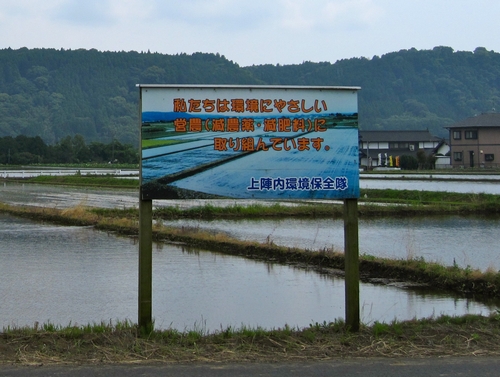
In the district surrounding Kumamoto City, most daily life water supplies come from groundwater, and groundwater levels have declined in recent years due to the decreased number of wet-field rice paddies under cultivation. The amount of groundwater recharge (the amount of surface water seeping into the ground) in the Kumamoto district is 640 million tons a year, and one third of this amount comes from rice paddies. Rice paddies along the midstream of the Shirakawa River in particular provide five to 10 times more water as rice paddies in other areas. However, the number of rice paddies functioning as part of the recharge system has decreased. The area of wet-field rice being planted declined from 15,000 hectares in 1990 to 10,000 hectares in 2011.
This was the background to the recharge project started in Kumamoto. In the late 1990s, Professor Tsutomu Ichikawa at Tokai University reported that spring water feeding Ezu Lake in Kumamoto City decreased by 20 percent in 10 years. At that time, the Sony corporate group decided to build a semiconductor factory (Sony Semiconductor Co.'s Kumamoto Technology Center) in the groundwater recharge area. Because large quantities of groundwater are needed to produce semiconductors, local people were worried that the factory might pump up so much water that it would impact surrounding areas.
Their worries induced Sony to consider various measures. In fiscal 2003, Sony started a groundwater recharge project working cooperatively with local farmers, environmental NGOs and agricultural organizations. The project sought farmers who would cooperate by introducing water from the river into their paddy fields during the off season so as to recharge the groundwater. Sony offered to cover all expenses of the project. More recently, the Kumamoto Ground Water Foundation is collecting donations from small and medium-sized companies that use groundwater to promote recharge from rice paddies.
Conserve_Groundwater02.jpg
Copyright Junji Hashimoto. All Rights Reserved.

This project seems to be attracting favorable comments from cooperating farmers, for example, "It is good because weeds don't grow in flooded paddies. Removing weeds during this season is a hard work, so it is helpful," and "This project can eliminate replanting failure." Meanwhile, there is a movement to sell rice grown in these paddies as brand-name rice. By actively purchasing such local products, consumers can support the project. Buying rice cultivated in groundwater recharge areas makes a real contribution to maintaining groundwater resources.
By eating this rice, local people can protect agriculture as well as groundwater. Even local people working in Tokyo and Osaka can support their hometowns by eating this rice. Kumamoto City's efforts to build this social mechanism earned them the award.
Conserve_Groundwater03.jpg
Copyright Junji Hashimoto. All Rights Reserved.

Complete Replenishment Groundwater Recharge Rule Established in Azumino, Nagano
Among groundwater initiatives of local governments, the policy in Azumino City, Nagano Prefecture, stresses its groundwater recharge rule. In addition to rules on groundwater collection, such as requirements for notification or permission at the time of water withdrawal, it includes measures to proactively increase groundwater, such as introducing water into paddies that would benefit from crop rotation. These measures are paid for by taxes on companies and citizens.
In Azumino City, some people have been complaining over the last few years ago that the spring water levels have become lower, affecting the cultivation of wasabi horseradish, a specialty crop of the area, killing the plants or otherwise making their cultivation impossible. Spring water and groundwater in Azumino are used for fish farming, agriculture and wasabi culture as well as for people's daily life needs and industry. In spite of the efforts of people to point to the sinking water table, there were no rules concerning groundwater use, and no specific measures for its preservation or recharge.
In July 2011, stakeholders established the Groundwater Conservation Study Committee, headed by Katsuyuki Fujinawa, a professor of geohydrology at Shinshu University. Initially, committee members were at loggerheads because they had been in conflict over the use of groundwater. They had been blaming each other for the decrease in groundwater, for example, saying "Bottled water makers take too much groundwater," or "The excessive expansion of wasabi cultivation is the cause of decreasing groundwater levels."
Clean water is essential to grow wasabi. Wasabi growers carried out surveys of spring water and found that volumes were decreasing each year. They asked the city government to take the necessary action to conserve groundwater. "The intake by bottled water makers, as well as by the city for tap water, lowers the water table and depletes springs, damaging the cultivation of wasabi, a major component of Azumino's industry and a driver of tourism," wasabi farmers declared.
On the other hand, bottled water makers said, "We are publicizing the attractiveness of Azumino through nationwide sales of local brand-name spring water flowing from Japan's Northern Alps." They also insisted that they were providing benefits to the city, for example by hiring local people in cooperation with the city government. Caught between wasabi farmers and bottled water makers, the city government was at a loss over how to cope with the situation.
In the Groundwater Conservation Study Committee, Chairman Fujinawa focused on the results of groundwater level research conducted in 1986 and 2007, which revealed that groundwater under the city had decreased at a rate of six million tons annually. Based on this data, he made an appeal to committee members, saying "We must recharge our groundwater if we want to continue using it for many years to come. To this end, all users should join hands with each other." His concluding exhortation - "Now, let's work together!" finally united the entire committee.
Conserve_Groundwater05.jpg
Copyright Junji Hashimoto. All Rights Reserved.

Azumino lies in the middle of the Matsumoto Basin located on the upper reaches of the Shinano River, the longest river in Japan. Layers of sand and gravel up to several hundred meters thick are deposited in this basin; gravel aquifers hold large amount of waters. This one holds a volume of water equivalent to two-thirds of the total storage capacity of Lake Biwa, Japan's largest lake. Azumino's local economy has benefited greatly from this rich resource, to the tune of 85 billion yen (about U.S.$867 million) from bottled water, 7.6 billion yen (about U.S.$78 million) from tourism such as wasabi cultivation tours, 3.6 billion yen (about U.S.$37 million) from wasabi sales, and 2 billion yen (about U.S.$20 million) worth of tap water.
Stakeholders who once blamed each other for the groundwater depletion changed their attitude and started working together to conserve their common resource. Their focus shifted from "water used so far" to "water to be used in future."
In August 2012, the committee compiled a final report and submitted it to the mayor. This report deals with two major topics, namely specific ways to recharge aquifers and how to calculate charges on the use of groundwater. Recharge projects are to be paid for by cooperative funds collected from groundwater users. The report confirmed that groundwater fees should be calculated by a specific formula, and paid by a wide, shallow base of users continuously over time.
The calculation formula is as follows:
Unit price of groundwater x Amount used (intake minus amount recharged) x Coefficient of payment capacity (capital level and percentage of foreign capital) x Coefficient of influence on the resource (the deeper the well, the greater the impact)
With this formula, the more groundwater is recharged, the lower the rates users have to pay. Active efforts by users to recharge groundwater will decrease the "Amount used," potentially lowering the burden of fees nearly to zero. This system will help stop the decrease in groundwater. Such concretely defined ways to recharge groundwater and levy fees for its use are very unusual in Japan. It is expected that an increasing number of municipalities will be referring to these "Azumino Rules."
We will be keeping an eye on municipalities' initiatives to conserve groundwater and hope to be able to support their efforts.
Conserve_Groundwater06.jpg
Copyright Junji Hashimoto. All Rights Reserved.

Written by Junji Hashimoto
Journalist specializing in water issues

segunda-feira, 11 de novembro de 2013

Walkability em São Paulo

Walkability | 09/11/2013 07:40

São Paulo a pé (e em linha reta) é possível?


Pela 1a vez, um bairro paulistano vai testar a aplicação do conceito “walkability”, que mede a "caminhabilidade" e indica o quão bom a região é para o pedestre


CreativeCommons/Jurandir Lima/ Flickr.com/jurandir_lima
Calçada esburacada na Av. Paulista
Buraco à vista: a lista de “pedras” no caminho de quem vive nos grandes centros urbanos é grande
São Paulo – Buracos que se multiplicam, calçadas pequenas e insuficientes, falta de sinalização, ruas mal iluminadas à noite, nenhum banco à vista para descansar, dezenas de sacos de lixo no meio do trajeto que nos obrigam a andar pela rua...A lista de “pedras” no caminho de quem vive nos grandes centros urbanos costuma desanimar até os mais entusiastas do estilo de vida sustentável.
Mas uma iniciativa pioneira em São Paulo pode ajudar a melhorar a vida do pedestre. Pela primeira vez, um bairro da cidade vai testar a aplicação do conceito “walkability”, que pode ser traduzido como “caminhabilidade”. A ação, que acontece neste sábado (9), na Vila Madalena, procura responder a uma pergunta principal: o quão bom o bairro é para o pedestre?
O programa consiste em uma caminhada com moradores ou visitantes para medir diversos aspectos que fazem um bairro ser bom para o pedestre, e também busca informações para responder questões importantes sobre qualidade de vida nas cidades. Apesar de ser um dos bairros mais "cool" da cidade, com gente andando a pé e se encontrando nas ruas e praças, a Vila Madalena também tem problemas. Suas ruas inclinadas acumulam degraus nas calçadas, buracos e outros obstáculos para o caminhante, e os bares fazem com que as ruas estejam sempre lotadas de carro, com pouco espaço para um agradável e seguro ir e vir.
Como se mede a caminhabilidade
Ter muitas árvores é bom ou ruim? Há lugar para sentar no meio de uma caminhada? Arte de rua torna o passeio mais agradável? Se sente seguro andando no bairro? As calçadas são boas e a topografia ajuda? Essas e outras perguntas serão levantadas durante a caminhada, que sai às 15h do metrô Vila Madalena.
O passeio é capitaneado pelo Instituto Mobilidade Verde, que promove discussões sobre a ocupação do espaço público de forma sustentável, e os coletivos Sampapé, que faz caminhadas socio-culturais e o Conexão Cultural, realizador dos Walk Tours.
A partir dessa expriência, será montado um relatório que ficará à disposição dos moradores e dos gestores públicos. Essa metodologia também pode ser aplicada em outros bairros da cidade. A ideia é engajar, principalmente, a comunidade local, uma vez que são os moradores que mais sabem sobre os altos e baixos de seus bairros. “As cidades foram pensadas para carros ao invés de pessoas, e a gente não conhece o que precisa mudar de fato para o pedestre. Mas com caminhadas como essa nós descobrimos o que é preciso melhorar”, diz Manuela Colombo, do Conexão Cultural.
Com a iniciativa, São Paulo passa a integrar o “Global Conversation”, um projeto da Fundação Jane's Walk do Canadá, que aplica a Metodologia "Walkabilty". Também participam do Global Conversation as cidades de Toronto, Victoria, Cidade do México, Guadalajara, Tel Aviv, Johanisbourg, Calcutá, Ljbljana e Istambul.

Doar o excesso de calorias para alimentar os países em desenvolvimento

Donate Excess Calories to Feed Developing Countries
Metavolunteer.jpg
Copyright Metavolunteer. All Rights Reserved.

Metavolunteer, an NPO established on May 25, 2009, has been carrying out a project to provide food to famine victims. Under the slogan "Your Fat Can Save the Earth," the project aims to improve general health by organizing sports events and selling healthy foods. The NPO converts each calorie burnt or consumed in such events or foods into yen, and appropriates the yen value to provide food for starving people overseas. The donated funds come from event participation fees and support money from businesses.

One of the events organized to date is Meta bowling, a monthly bowling tournament that burns 50 kcal per game and has so far provided 3,414 meals in Bangladesh. As an example of food sales, they sold rice balls containing Konnyaku, made by mixing konjac flour with water and limewater, with 40% fewer calories than regular rice balls, and donated one loaf of bread per rice ball sold, providing an additional 3,019 meals to Bangladesh.
There are now thought to be one billion obese and another one billion starving worldwide. By participating in the NPO's program, it is hoped that overweight or obese people can become healthier, and in doing so, help others. The NPO hopes that this would provide motivation for non-starving populations to engage in activities to stay healthy.
Posted: 2013/10/26 06:00:00 AM

domingo, 10 de novembro de 2013

Pensão alimentícia pra cachorro


Pensão alimentícia pra cachorro

Publicado por Espaço Vital - 15 horas atrás
18
A mulher ingressa com ação de separação e requer liminarmente pensão para si, até que consiga emprego. Pede também que seja ordenado ao varão que retire da residência dois cães de caça que lá deixara, ou que a juíza autorize a venda ou a doação dos animais.
Segundo a petição, "os bichos estão, junto com a mulher, passando necessidades".
O homem - embora separado e já morando com outra companheira - mantivera os cachorros na casa, para ter uma desculpa de frequentar o lar da ex. Quando esta cansa das visitas, surgem as discussões e ele deixa de, espontaneamente, prestar alimentos. Também não fornece mais a ração dos cachorros.
Ele contesta, alegando não ter para onde levar os cães, ainda mais considerando que um deles está doente". Deixa a decisão sobre o destino dos cachorros"ao prudente arbítrio de Vossa Excelência, tanto mais que os animais têm a proteção da legislação ambiental".
Em audiência, a magistrada expressa que" cachorro é como filho, tem-se que cuidar pelo resto da vida ". Mas não há acordo.
Ocorre, então, decisão indeferindo o pedido de pensão alimentícia à ex-mulher e de retirada dos cães. Acolhida a ponderação do varão de que não tem para onde levar os animais - e, diante da situação de penúria da ex-mulher, que alega" não poder alimentar nem a si mesma "- a juíza determina ao varão, a prestação de alimentos 'in natura' aos animais:" 30 quilos mensais de ração canina de boa qualidade ".
Infelizmente a mulher não recebeu o mesmo cuidado, porque há uma tendência das juízas em decidirem contra as mulheres " - é um dos argumentos do agravo de instrumento.
Antes do julgamento do recurso, os advogados obtêm a conciliação das partes. O homem doa os animais a um amigo caçador e aceita pagar dois salários mínimos mensais de pensão à ex-cônjuge.
Perde-se, assim, a possibilidade de saber se - confirmando a decisão - o TJ criaria o primeiro precedente jurisprudencial de pensão canina.